

By Brad Stroh
Co-CEO & Founder at Achieve
Last Sunday, my family told me they had a surprise.
My daughter flew up from her summer internship in Los Angeles. My son joined us on Zoom from his internship in New York. My wife, Brandy, sat me down in the backyard. I am generally pretty involved in our family decisions, so I knew something unusual was happening. I just did not know what.
Then a minivan pulled into our driveway. The door opened and out bounded an 8-week-old golden retriever puppy named Biscuit.

My first thought was not particularly positive: “Oh sh-t!” We do not have room for this kind of chaos.
We already have Bucky, our 8-year-old white Lab. We had our routines. Our days had a rhythm; when we woke up, when we worked out, when I went to the office and when we went to bed.
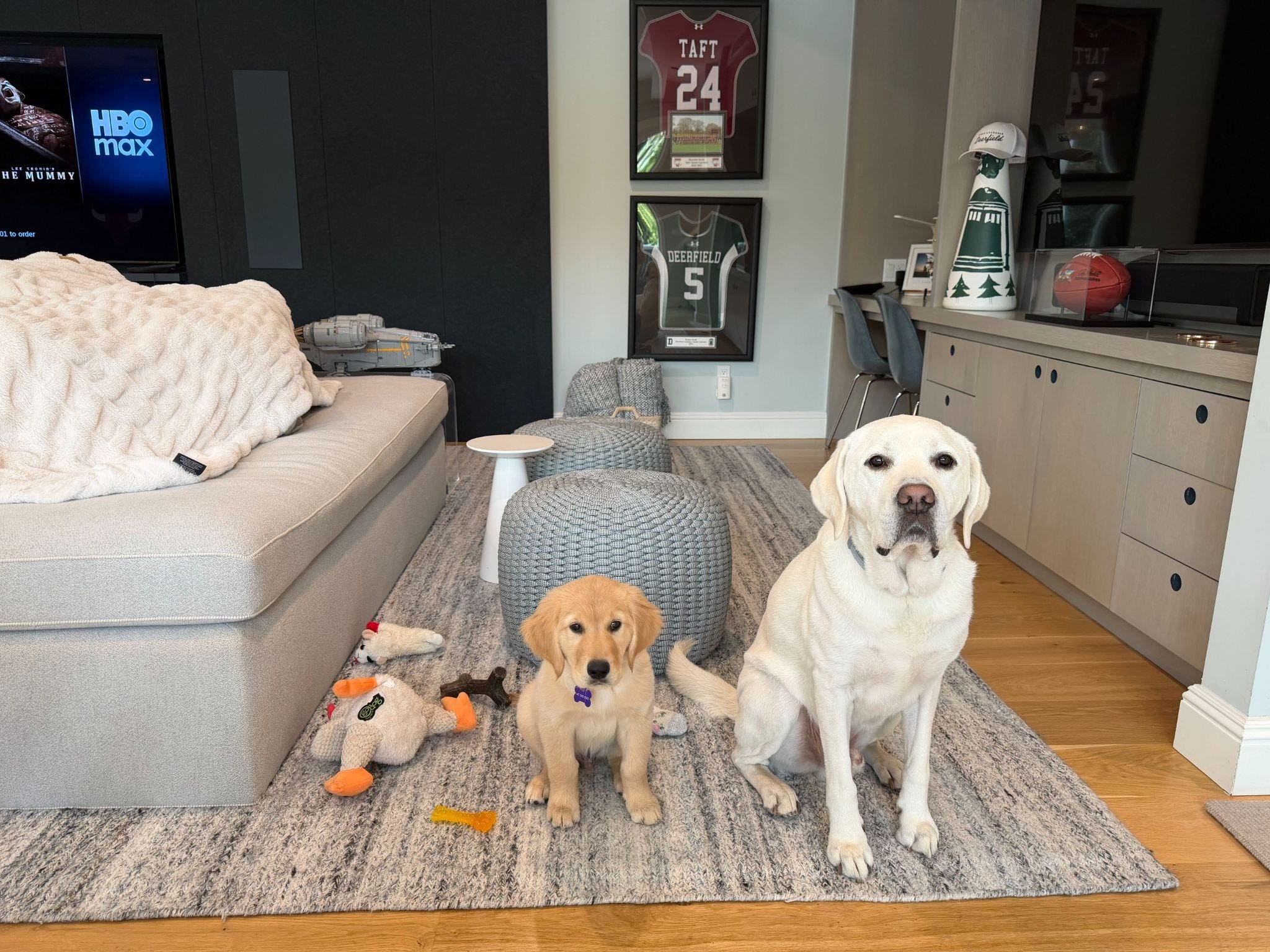
Between running a company, serving on boards, coaching and trying to be a present husband and father, life was already full.
Then Biscuit ran up to us, and almost instantly, the calculation changed.
Puppies have a way of doing that. In a matter of seconds, the disruption becomes joy. Of course, it is still disruption. Biscuit has peed on the rug, thrown up at 2 a.m., barked from his crate and interrupted just about every established pattern in our house. But he has also brought an incredible amount of energy and love into our family.
A few days in, I couldn’t help but reflect on how much a surprise puppy resembles change inside a business.
Change does not conform to your operating model
When you introduce a puppy into your life, the chaos does not magically organize itself around your schedule. You have to adapt to it.
The same is true when a company launches a new product, adopts a new technology, enters a new market or changes how a team operates. Leaders may describe the initiative neatly in a presentation. The actual experience is rarely neat. New work collides with existing priorities. Familiar routines stop working. People who thought they were on stable footing have to learn a different way of moving.
That friction is not necessarily evidence that the change was a mistake. Often, it is evidence that the change is real.
The instinct to protect a well-run system is understandable. Structure, consistency and discipline matter. Predictability matters and is the foundation that many times is required to then launch innovations from. They allow teams to execute, customers to know what to expect and leaders to allocate resources with intention. But a company that becomes too protective of its routines can become old, sleepy and stagnant. Stability is valuable until preserving it becomes the goal.
Biscuit did not fit my prediction of how the week would go. Neither do most meaningful opportunities. Leadership requires the ability to recognize that distinction and reset quickly: This is not what I planned. It may still be exactly what we need. What can I do about it now and how do I need to adapt and embrace the change and coming chaos?
Not all disruption is good disruption
There is an equally important lesson on the other side: I could not take a house full of puppies.
One puppy introduced manageable disruption into a stable environment. Ten puppies would overwhelm it. The question for a leader is not whether change is good or bad. It is: How much parallel disruption can you introduce into the ecosystem, with what group, at what time and with what culture?
A business needs the capacity to absorb change. Considerations include financial flexibility, the right talent, clear priorities, strong leadership and enough trust across the team to work through the messy middle. Without those things, even a promising idea can create more disorder than value.
This is where ambition needs discipline. Innovation can be exciting, especially for builders. But if every team is absorbing a major change, every process is being reinvented and every priority is labeled urgent, people never find solid footing. A company cannot execute well when it operates as a permanent circus.
The goal is not constant disruption. It is intentional disruption — introduced at a moment when the organization has the strength to turn temporary chaos into lasting progress. And it has to be aligned on and then well executed.
Leaders set the emotional temperature
My family had already decided Biscuit was joining us. At that point, I had a choice. I could fixate on the inconvenience and make everyone feel the weight of my resistance, or I could put a smile on, roll with it and look for the value in what had arrived.
Leaders face versions of that decision all the time. A curveball hits the business. A market shifts. A plan fails. A new opportunity demands attention that no one had budgeted. Teams look to the leader not only for the next instruction but also for a signal about how to interpret the moment.
That does not mean pretending the disruption is painless. Good leadership is honest about the trade-offs. Biscuit is wonderful, and he is also a little unit of destruction. Both things are true. In business, leaders should be equally candid about the cost, complexity and uncertainty that come with change.
But candor is different from cynicism. Once a decision is made, the job is to help the team move forward with clarity and conviction. Resistance can become contagious. So can curiosity, flexibility and belief. We have a concept of “disagree and commit” and that can be a powerful moment for a team to unite, regardless of circumstance, on next best action and the future.
Make room for the right kind of chaos
The strongest organizations I know are neither rigid nor reckless. They build the systems, talent and trust that create stability, then use that stability as a platform for the next bold move.
That balance is hard. Too little disruption and the organization calcifies. Too much and people exhaust themselves reacting instead of building. The right amount challenges routines without destroying the foundation beneath them.
Biscuit has been a very disruptive new member of the Stroh family. He has also been an awesome one. For us, at this stage of life, the disruption is manageable and the puppy joy far outweighs the puppy distractions.

That is the calculation leaders have to make. Not: How do we eliminate every curveball? But: Do we have the strength and flexibility to absorb this one? Is the opportunity worth the disorder it will create? And if the answer is yes, can we stop wishing the moment looked different and lead the team through the reality in front of us?
Sometimes the thing that disrupts your plan is also the thing that brings new energy into the system. The leadership challenge is knowing when to open the door and how to respond. I have to go. Biscuit is crying at the door again.
Got any good (or bad) experiences with disruption in your own life? How’d you handle it?
Awesome article…inspirational and fun to read. Give Biscuit a hug from us!